
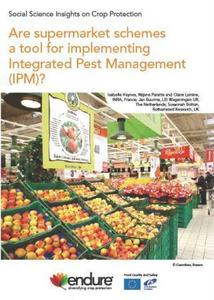
Social Science Insights examines supermarkets
A new Social Science Insights leaflet has been added to the ENDURE library, shedding light on the role played by supermarket produce schemes in the European food chain and examining their possible role in creating more sustainable crop protection practices.
Are supermarket schemes a tool for implementing Integrated Pest Management (IPM)? examines the increasingly important role of retailers’ produce schemes in European agri-food systems. These schemes have become an important step for producers wishing to sell fruit and vegetables to the larger retailers but, as the leaflet explains, are designed to ensure the food we buy looks good and is safe to eat rather than encourage integrated farming practices.
Retailers' schemes are rooted in the Hazard Analysis Critical Control Point (HACCP) method that seeks to control hazards which are significant to food safety, say ENDURE researchers, and most supermarkets implement this approach through Good Agricultural Practices (see GlobalGAP for more information).
Thus the emphasis for producers is on documenting their adherence to hygiene and safety rules, which in the case of pesticides means adopting storage rules, calibrating spraying equipment and wearing protective clothing when spraying. It also means implementing traceability and self assessment procedures, being subject to external inspections and the use of some substances considered as risk factors, such as human sewage sludge, is forbidden.
The ENDURE researchers conclude that this emphasis does little to promote integrated production, though it does increase the importance of new stakeholders, such as inspection staff, in the production chain.
For producers, they say, these schemes do not fully reward the efforts they have to make as supermarkets work on the basis of short-term contracts and provide no commitment to purchase. Furthermore, they note, even the most demanding of the supermarket schemes do not really favour IPM as they demand high physical quality standards and the growing of varieties that are reliant on pesticide use.
- Download Social Science Insights 2: Are supermarket schemes a tool for implementing Integrated Pest Management?
Social Science Insights Number 2 - Supermarket schemes [pdf - 400,07 kB]
- Also available in the Social Science Insights series: Number One: The conditions of transition towards IPM practices
Social Science Insights Number 1 - Transition [pdf - 437,09 kB]
- To consult all ENDURE's publications, click here.
Last update: 24/05/2023 - ENDURE © 2009 - Contact ENDURE - Disclaimer