
Deploying disease resistance in crop cultivars
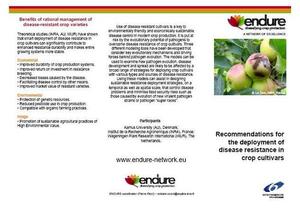
Intelligent use of disease resistance in crop cultivars can significantly contribute to enhanced resistance durability and make entire growing systems more stable, explain ENDURE experts in their new leaflet, Recommendations for the deployment of disease resistance in crop cultivars.
The authors, from Aarhus University, Denmark, France’s National Institute for Agricultural Research (INRA) and Wageningen Plant Research International in The Netherlands, say that rational management of disease resistant crop varieties provides mutliple benefits.
These benefits are both economic and environmental, and can also be good for the image of agriculture, promoting sustainable agricultural practices, say the authors. The economic benefits include improved durability of crop production systems, better returns on investment in resistance breeding and reduced losses from disease. Environmental benefits include the protection of genetic resources, reduced pesticide use and compatibility with organic farming practices.
The authors explain that while using disease resistant cultivars is a key component of environmentally friendly and economically sustainable pest control, the ability of pathogens to evolve and overcome this resistance is problematic.
They present three different modelling tools, one from each institution, which have been developed to consider the key evolutionary mechanisms and driving forces behind pathogen evolution.
These models, they say, can be used to examine how pathogen evolution, disease development and spread are likely to be affected by a broad range of strategies for deploying crop cultivars with various types and sources of disease resistance.
Using these models can therefore assist in designing sustainable resistance deployment strategies that control disease problems and minimise food security risks such as those caused by the evolution of new virulent pathogen strains or pathogen ‘super races’.
Publications from ENDURE’s team dedicated to the exploitation of plant genetic resistance
| Cover | Title | Download (pdf) |

|
Recommendations for the deployment of disease resistance in crop cultivars | |

|
Conceptualizing disease management by use of resistant cultivars: three models for host-pathogen dynamics |
Last update: 24/05/2023 - ENDURE © 2009 - Contact ENDURE - Disclaimer