
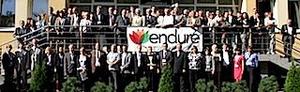
Building European bridges for IPM implementation
Reducing pesticide use and risk remains high on the agenda of EU Member States, and for the third time since 2007, a Member State has taken advantage of its EU Presidency to organise a policy seminar on the issue. The latest seminar was staged earlier this month by Poland’s Ministry of Agriculture and Rural Development, and focused on ‘Sustainable use of pesticides and Integrated Pest Management (IPM) in East-Central Europe and the Baltics.’
The event was held September 5-6 2011 at IHAR ( Plant Breeding and Acclimatization Institute ) in Radzików, Poland, with ENDURE providing scientific support in the organisation of the event, and provided an opportunity to share and strengthen links among organisations involved in agricultural research, policy and extension ranging from Western to Central and Northern Europe and the Baltics. It was attended by 104 participants from 12 countries.
The meeting showed that a certain level of regional coordination is already in place. There are several examples of this. The PesticideLife+ project facilitates exchanges between Nordic and Baltic countries to promote the goals of the Framework Directive on the sustainable use of pesticides. The project DSSHerbicide is set to adapt an online Decision Support System (DSS) for weed management from Denmark (Crop Protection Online) to Northern Germany and Poland. Nordic countries regularly meet to discuss pesticide resistance issues via NORBARAG, the Nordic Baltic Pesticide Resistance Action Group. But cross-European opportunities for exchange are scarce, hence the interest in initiatives such as this one.
Marek Sawicki, Poland’s Minister of agriculture and rural development, opened the conference and stressed the important role that research plays in supporting the development of new approaches to crop protection that respond to the health-related demands of the public. The Minister made it clear that the currently controversial use of biotechnology in crop protection was a major source of preoccupation.
Delegates from Poland’s government gave details about a proposed national action plan on the reduction of risks associated with the use of plant protection products. The plan, which is currently undergoing public consultation, makes a number of references to IPM within the framework of Integrated Production based on IPM crop-specific guidelines. Much attention is placed on the need for market incentives in favour of IPM, with the creation of an Integrated Production label as part of this approach.
The question of the economics of IPM was implicit in several presentations on national situations. Speakers from Slovakia and Hungary, for example, explained that past IPM initiatives in those countries had been based on national programmes relying on farmer subsidies. In other countries, such as Lithuania, training programmes were the main lever emphasised to promote IPM.
Resistance to pesticides was highlighted in several talks, in particular management approaches to prevent it and new techniques to monitor its appearance. The issue of using doses lower than the manufacturer recommended rate was also addressed in the context of suspicions that this would favour the evolution of resistance. However, current experimental evidence shows that satisfactory control of weeds and diseases can frequently be obtained with less than the recommended dose without an added risk of promoting resistance.
From Germany, the concept of ‘necessary minimum’ retained the attention of delegates. It is an original expert-based communications and evaluation tool whose baseline shifts yearly. The ‘necessary minimum’ describes a level of pesticide use that combines efficacy and the minimum quantity necessary taking into account a diversity of parameters, including local circumstances and availability of non-chemical measures. The discussion brought to light the challenge of defining a necessary minimum quantity that would enjoy widespread acceptability.
Much attention was also given to the more technical dimension of crop protection, including realising the potential of biological control, implementing the Integrated Production guidelines produced by the International Organisation for Biological Control, further developing plant breeding and mitigating environmental impact with optimal pesticide use techniques.
The particularly difficult challenge of developing IPM when faced with potato late blight was the subject of several talks, with, for example, extensive DSS systems developed in Estonia and Poland, or the prospects in the Netherlands of combining cis-genesis for host-plant resistance with new management techniques, including monitoring pathogen virulence to sustain that resistance.
The meeting showed that there is a demand and a need for such cross-European interactions and that ENDURE, as a facilitator and as a source of tools and resources, can play an important role in this respect. ENDURE looks forward to building on these cross-European interactions to promote synergies and experience-sharing among policy, extension and research organisations for the development of more sustainable approaches to crop protection.
All presentations given at the conference are now downloadable as pdf files below:
| Name / affiliation | Download pdf |
| Antoine Messéan, INRA / ENDURE |
Antoine Messean The ENDURE Network [pdf - 204 MB]
|
| Dijana Ruzgiene, Lithuanian Agricultural Advisory Service | |
| Zbigniew Dabrowski, Warsaw U. of Life Sciences |
Zbigniew D?browski - Update on IPM in Poland [pdf - 596 MB]
|
| Bernd Hommel, Julius Kuehn-Institut |
Bernd HOMMEL - Prospects for IPM in Germany [pdf - 474 MB]
|
| Silke Dachbrodt, JKI & Marco Barzman, INRA / ENDURE | |
| Per Rydahl, Aarhus U. | |
| Kari Tiilikkala, MTT Finland | |
| Marta Magdolenova, Dept of Plant Protection, SK |
Marta Magdolenova - Prospects for IPM in Slovakia [pdf - 67820 kB]
|
| Marek Tomalak, Institute of Plant Protection, PL | |
| Krzysztof Kielak, Ministry of Agricultre and Rural Development, PL | |
| Mati Koppel, Jõgeva Plant Breeding Institute, EE | |
| Per Kudsk & Lise Joergensen, Aarhus U., DK | |
| Huub Schepers, Wageningen U., NL | |
| J. E. Jensen, Agricultural Knowledge Centre, DK |
Jens Erik Jensen - Resources for advisory services [pdf - 340 MB]
|
| Jozefa Kapsa, IHAR, PL | |
| Piet Boonekamp, Wageningen U., NL | |
| R. Holownicki & G. Doruchowski, Institute of Horticulture, PL | |
| J. Kiss, SZIE & G. Szalkai Ministry of Rural Development, HU | |
| Monika Fischer, Federal Office for Agriculture and Food, DE |
Monika Fisher - Innovation support programme Germany [pdf - 86928 kB]
|
| Edward Arseniuk, IHAR, PL | |
| Roma Semaskiene, Lithuanian Research Centre for Agriculture and Forestry |
Last update: 24/05/2023 - ENDURE © 2009 - Contact ENDURE - Disclaimer